Sunday, February 13, 2011

DAY 11: OCT 16 ALDEA DEL CANO TO CACERES (24 KM) 33,197 STEPS

This was an uninteresting day. There was an 11-arch Roman bridge over the Rio Salor on the outskirts of Valdesalor where archaeological work had been done to expose the old Roman road which lies a scant 50 cm below current ground level.

Sign explaining the archaeological excavation

Caceres is an interesting old town. The early history goes back to Roman times but there is little to be seen of that era. The compact, pedestrian-friendly old town which is entirely surrounded by stone walls goes back to the fifteenth and sixteenth centuries. It is full of grand homes, the result of the treasurers that poured into the city from conquistadors returning from the Americas. It is a vibrant city with many restaurants and a vibrant night life.

Entrance to Caceres

Old town Caceres
The only remaining fortified tower


DAY 12: OCT 17 CACERES TO CASAR DE CACERES (11 KM) 14,581 STEPS

My original plan had been to make this a rest day but Franck pointed out that it made a lot more sense to make it a half-rest day by walking the 11 km to Casar de Caceres thereby avoiding a 46 km walk to Canaveral the following day. The walk took only two-and-a-half hours albeit mostly along the shoulder of a surprisingly busy secondary highway. Not far from my destination I had to share the path with a shepherd and his dogs and flock.


This lengthy trellised promenade was like a red carpet
guiding us into Casar de Caceres 

The albergue was excellent. Eventually most of the 24 beds were filled, primarily with hikers. We met a couple of brothers who had started their Camino from their home town  in Switzerland. Over five months they had walked to France making their way into Spain by crossing the Pyrenees Mountains. Then, on to Barcelona,  Granada and Sevilla. They were going to Santiago de Compostela from where they would walk the Camino del Norte in reverse before making their way home via France. Total distance - a whopping 6000 km!

Entrance to the albergue


Typically crowded but clean albergue

The Swiss brothers
 
The town is famous for a cheese that is made from sheep's milk, Torta de Casar. I took the time to tour the local cheese museum that focuses on the historical way of making the cheese as well as more modern methods now employed. It was very interesting and  of course I had to buy some. The cheese is runny to the point where you spoon in onto your bread. It's smelly but once you get it past your nose it tastes really good.   

DAY 13: OCT 18 CASAR DE CACERES TO CANAVERAL (35 KM) 46,707 STEPS

This was to be the first of four very tough stages primarily because of the length but also because of the limited availability to resupply water. Initially it was raining lightly and cool and I was tempted to dump a liter of water but wisely decided  to stick with the original plan of taking four liters (~ 9 pounds). Within an hour the rain stopped the sun was shining and it started to get very hot.

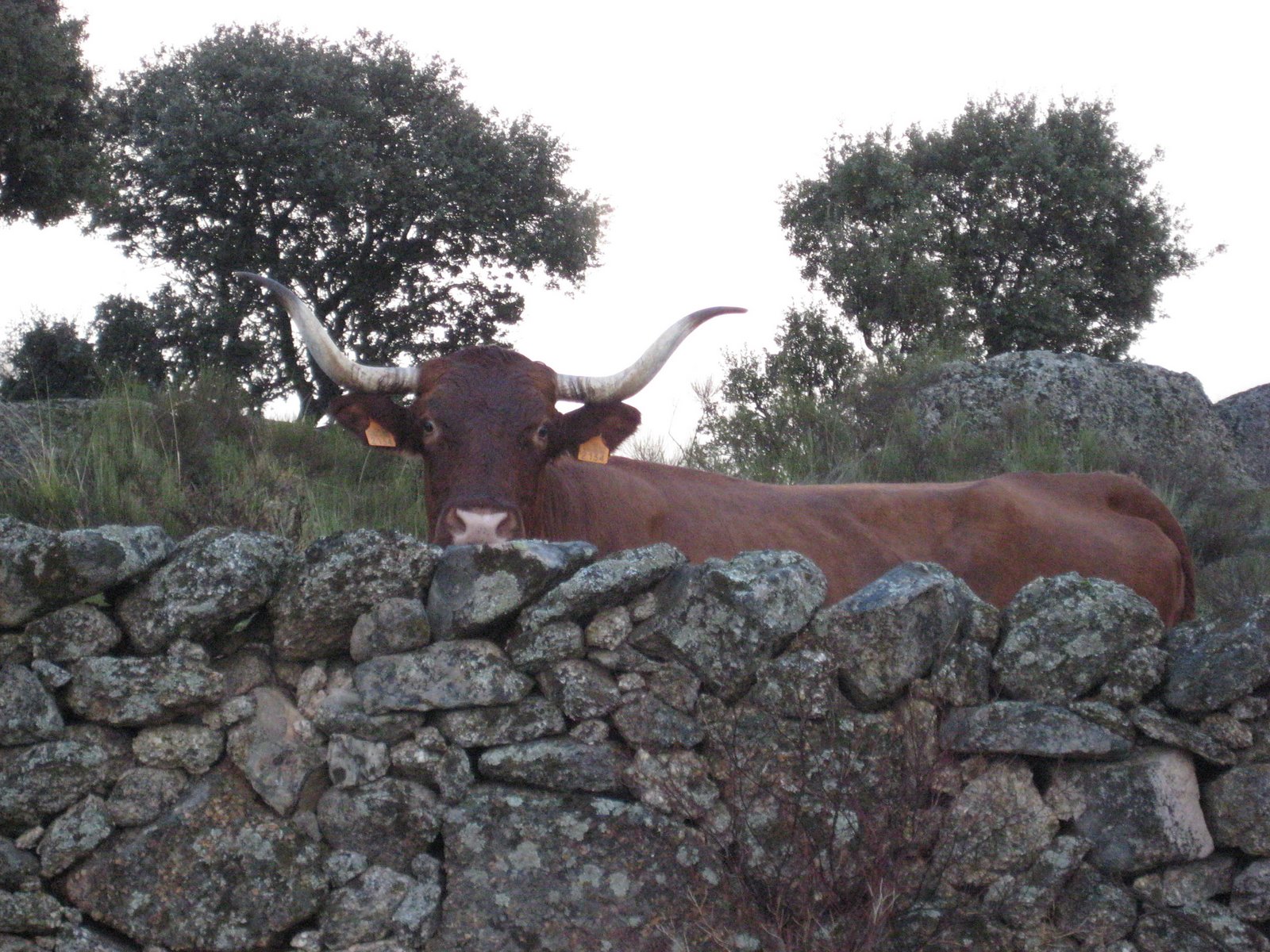
I'm glad this guy was on the other side of the stone wall.

A "miliario" graveyard. Some time over the last 2000 years
 these must have been uprooted and moved to this location

Typical farm road  enclosed by dry stone walls.
Stone is plentiful and cheap.

In the distance is the ":Embalse (reservoir) de Alcantara"


First view of Canaveral

Canaveral has a tiny albergue - 6 beds and only cold water for the shower. So, I decided to stay at the Hostal Malaga (20) euros with lots of hot water and a bathtub.  It was like heaven and I slept for 10 hours after a dinner with Franck and Angel, a policemen from Barcelona


DAY 14: OCT 19 CANAVERAL TO CARCABOSO (41 KM) 53,952 STEPS

Franck stayed at the albergue and we missed each other in the morning and thus were unable to co-ordinated where we would meet at the end of the day.

When your guide book says that the next section is "not suitable for cyclists, including mountain bikes" you know that there is a steep, difficult climb ahead. And so it was. Fortunately it was less than a kilometer in length.

In this photo the steep section doesn't look as forbidding
 as it seemed at the time. Ahead is Angel. It was
the last time that I would see him on the Camino.

The rest of the morning was a pleasant walk through forests of pines and old cork oaks. The only sounds were the birds, the occasional "clunk" of a sheep's bell and the ever present sounds of  walking...a creaking backpack, the sound of the walking stick hitting the ground and feet complaining about the ever present weight they were carrying.
This part of the Via de la Plata is greener than any other so far, as it is irrigated by networks of canals and aquaducts that pepper the region.

   One of the many irrigation aquaducts.

I had considered stopping for the night at Galisteo, a lovely 9th century city with walls 11 meters high but I felt really good and decided to carry on for an additional 11 km to Carcaboso As I passed the local albergue I met Petra, a very tall German girl, who joined me for the walk to Carcaboso.

 The approach to Galisteo.


The 11 meter wall surrounds the old city of Galisteo. 

The bar in Carcaboso, Bar Ruta de la Plata, has great accommodations for pilgrims. It is owned by Elena who is famous for her tostadas and what is rumoured to be the largest cafe con leche on the Via de la Plata. 


Petra was walking portions of the Camino before taking on the role of "hospitalera" (a volunteer who runs an albergue) in Salamanca. As far as I know Salamanca is the only albergue on the Via de la Plata that has a hospitalero.

DAY 15: OCT 20 CARCABOSO TO ALDEANUEVA DEL CAMINO (38 KM) 52,896 STEPS

I have never been as tired and sore as I was when I finally arrived at the albergue in Aldeanueva del Camino after nine hours of walking. The guide book gave the distance as 38 km.  It lied.  My pedometer said almost 41 and I know it was right.

The first 20 km were fine with lovely vistas and a good trail. But in the heat of the day the last half was agony while mostly walking along the shoulder of highway N630 with little or no shade from the relentless sun. It was hard to believe that it was in the low 30ies in the middle of October.

One of the most astonishing sights on the Via de la Plata is to suddenly, in the middle of nowhere, come upon the abandoned Roman city of Caprera. It is named after the  magnificently preserved  four-sided arch, Arco de Caparra through which the trail passes.


This view is perpendicular to the previous photo

The city is believed to have been built in the second century. There are extensive archaeological excavations taking place of the surrounding area, including the forum, the baths and the main street.


I think this is a modern reproduction of a miliario.

On arrival at 5:30 I was surprised to see Petra, who was still in her bunk at the albergue when I left in the morning. Turns out she had hitched a ride rather than walk along the highway. Even more surprising was the arrival of Franck at 7:30. He had walked the 49 kilometers from Galisteo. He is unbelievable!

The tiny albergue had four beds downstairs and five upstairs. Every bed was awful. It was as if the villagers had decided to open an albergue and then asked for donations of the worst bed that could be spared. But I was so tired that I didn't care.

DAY 16: OCT 21 ALDEANUEVA DEL CAMINO TO FUENTERROBLE DE SALVATIERRA (42 KM) 54,952 STEPS

Originally the plan was to walk the 34 km to Valdelacasa but I felt really good because of the cloud cover and the more seasonal temperature and decided to continue on for a further eight kilometers to Fuenterroble de Salvatierra. I also wanted to stay at the famous albergue there, operated by Don Blas Rodriguez, the parish priest, who has done much to revitalize the Camino in this region.

Some ten kilometers after leaving the albergue, I passed through the resort town of Banos de Montemayor. This is another Roman city famous for its thermal baths. Petra and Franck decided to have a soak in the spas but I opted to carry on. This turned out to be my last contact with them on the Camino.

There was a fairly rigorous two kilometers climb as I left the town but the views were spectacular.

A well preserved section of the Roman road out of Banos de Montemayor


Looking back at Banos de Montemayor

Then there was a glorious 15 kilometers of walking on a trail with forests on both sides and the sound of a river rushing through the valley below.


An ancient miliario and modern yellow paint point the way.

An interesting fountain for pilgrims to use.
Unfortunately there was no guarantee that the water was potable.

Towards the end of the day the sky started to darken and I picked up my pace to try to outwalk the upcoming rain. Needless to say, I was unsuccessful and I got soaked as I squished my way into the village. A semi-hot shower and some food improved the situation. There wasn't much point in washing and drying my clothes.


The albergue in Fuenterroble de Salvtierra

 The albergue in Fuenterroble de Salvatierra


The sleeping quarters.

DAY 17/18: OCT 22/23 SALAMANCA REST DAYS

During the night you could hear the wind and the rain pounding on the albergue. In the morning it was still coming down in sheets. The street fronting the albergue was a small river of water. Of the nine people staying at the albergue, four hikers decided to pack it in and return  by car to their homes in Salamanca. The rest of us waited hoping in vain that the rain would abate. Eventually, four decided to leave but I decided to wait a bit longer. The four returned in about  forty minutes having been turned back by a torrent water on the trail that was too dangerous to cross. So, I decided to take the bus to Salamanca some 50 kilometers away.

However, to catch a bus I had to make my way to the nearby town of Guitelo about 6 kilometers to the east. I flagged down a car on the road and a very kind gentleman drove me right to the bus station. You have no idea how difficult it is to converse when absolutely no one speaks English and you speak very little Spanish.

Eventually I got on the right bus and an hour later I was in Salamanca making my way in the rain to the the plaza major (central square). With help from the turismo (tourist office) I found a nice hostal with a BATHTUB and a place to rinse my laundry...the bidet. HEAVEN! It continued to rain until the early evening and then the weather turned cold. It was -1C the following morning and snow had apparently fallen further to the north - unfortunately, the direction I was heading.

I felt badly about not walking this section but I had no choice since I couldn't remain at the albergue.

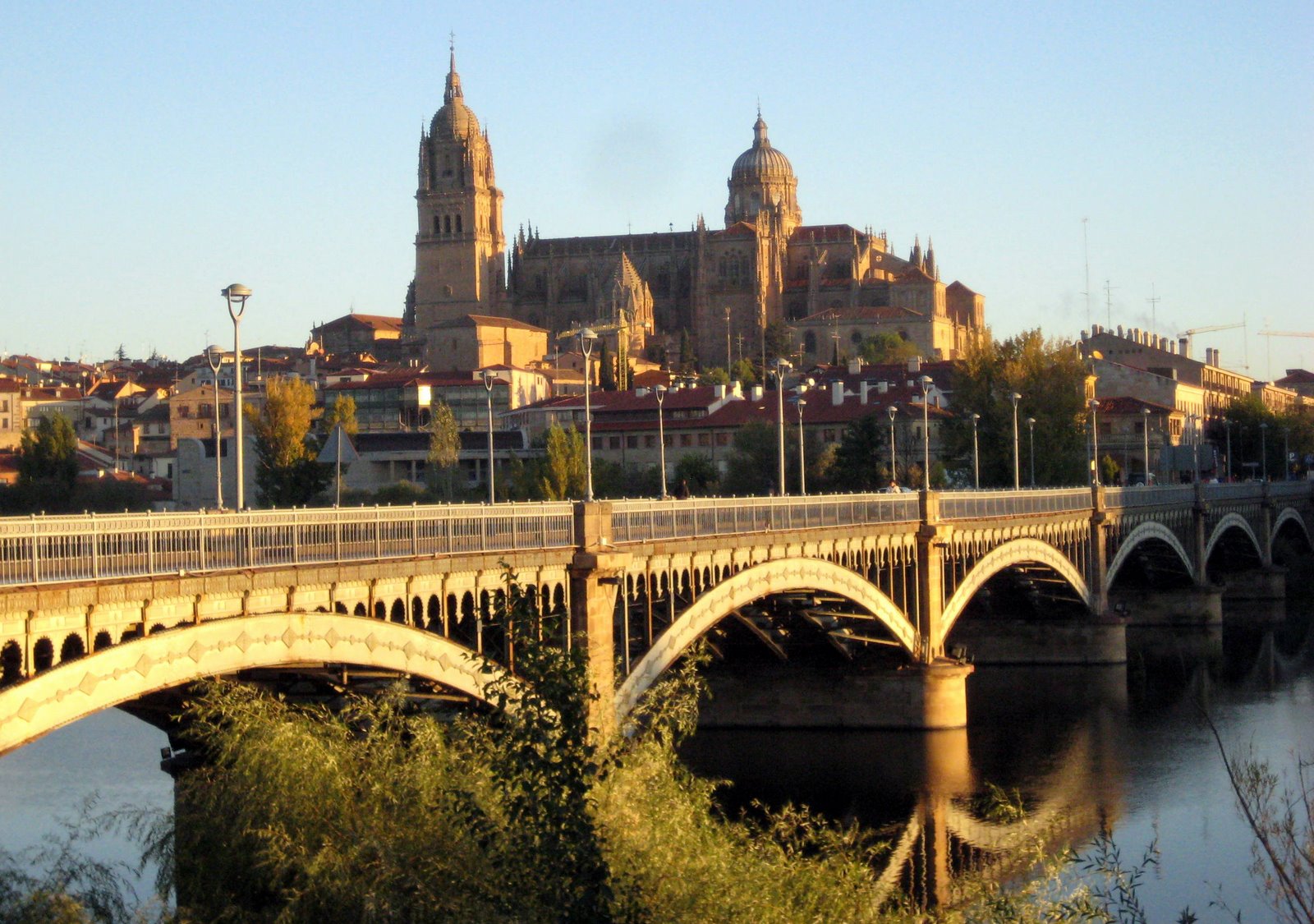
Even the rain couldn't hide that Salamanca is one of the most beautiful cities I have ever visited.

An astounding central square especially at night when it is lit up,....

 Salamanca's city hall which is part of the main square.


City hall by night

Two cathedrals (which is very unusual)....


Both cathedrals can be seen in this photo

A beautiful river with pedestrian walkways....


Superb public gardens....


... and history beyond compare.

The extra day gave me the opportunity to purchase a waterproof cover for my backpack. It cost 20 euros but it was worth it since it is almost impossible to put the poncho on while wearing a backpack without help, even under ideal conditions. It is impossible to do so under inclement conditions as witness the photo taken by Franck on day six. It's just a bad design.

Now I can put the poncho on first and then put the waterproofed backpack over top.


Lastly I was fortunate to be there on a day when the local Rotary club had a meeting. Fortunately I had brought a banner to exchange with the president of the club.

DAY 19: OCT 24 SALAMANCA TO EL CUBO DE LA TIERRA DEL VINO (35 KM) 49,471 STEPS

I was happy to be on my way again, leaving on a cool morning just as the sun was rising. The weather conditions were ideal for walking but unfortunately most of the trail markers had been obliterated by the ongoing construction of the new four-lane highway paralleling the existing N630. This forced me to walk some 20 kilometers along the shoulder of this very busy highway. It was an unpleasant experience.

The citizens of the tiny village of Calzada de Valdunciel provided me with a bench and a collage of broken miliarios as I ate my solitary lunch.


I arrived at the albergue after eight hours of walking only to find it closed. There was a note on the door with a telephone number to call.

Great.  If only I had a phone.

So, I walked back to the main square, found a bar and a fellow called the number for me and shortly thereafter the albegue was open. You have to be resourceful on the Camino.

Later in the evening as I sat by the opening of the albergue writing my journal a small local dog came along and laid down beside me. After a while he got up and ambled off. It was nice to have some company.

I was alone in the albergue (14 beds) but at least there wasn't any competition for hot water.


DAY 20: OCT 25 EL CUBO DE LA TIERRA DEL VINO TO ZAMORA (33 KM) 43,744 STEPS

Upon leaving it was a cool but comfortable 0 degrees C and it warmed up nicely as the morning passed in a gentle blur.

With the exception of about 1 kilometer the whole walk was on flat and boring country trails. Still, it was better than the previous day mostly along the very busy highway, N360.

As the Via de la Plata has become more popular, likely as a result of the hordes on the Camino Frances, local governments seem to be investing in more and upgraded facilities and markers. Here are some examples from this portion of the walk.

On the outskirts of Villanueva de Campean

Approaching Zamora. Note the symbols
of the Camino, the staff and the gourd.

Zamora is a small city on the Rio Duero. It was strategically located to control the river and was once enclosed by seven walls. The walls that remain have been well-preserved.

The cathedral and the imposing old city walls from across
 the river Duero


The old bridge and modern building cranes


The albergue had just recently been opened. It had the best facilities that I have ever seen on the Camino. Unfortunately it was so new that there were no utensils or pots and pans in the kitchen. Later a young lady from Germany joined me at the albergue.


The "empty" kitchen


The lounge


The main entrance